

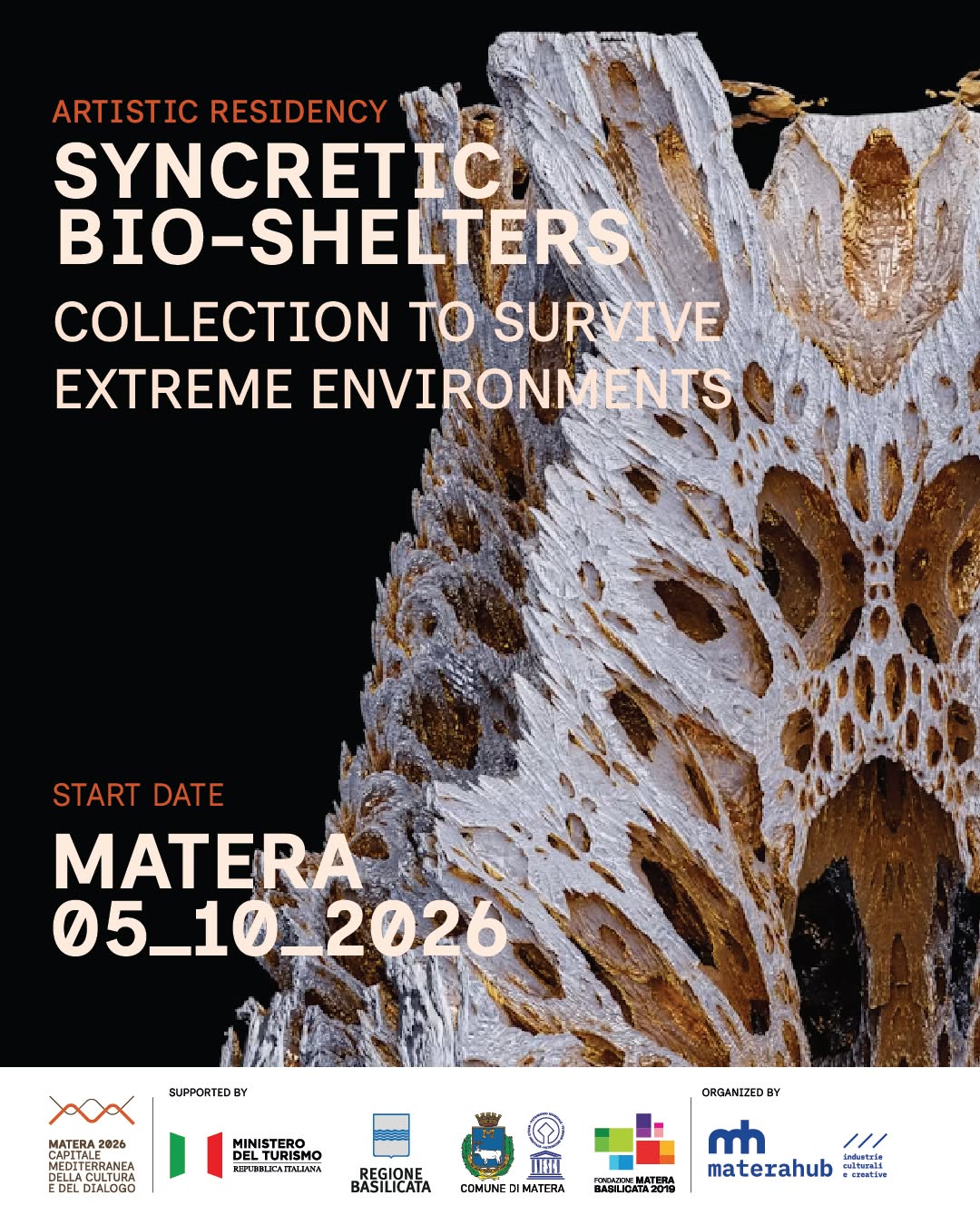
From 5 to 30 October 2026, Materahub will host Syncretic Bio-Shelters, a four-week artistic residency dedicated to the design and creation of functional costumes and accessories conceived to address the challenges of the climate crisis.
Syncretic Bio-Shelters are garments and wearable devices designed to provide protection and shelter from urban heat islands, solar radiation, smog and other effects of the climate emergency.
The residency also embraces a syncretic creative approach, exploring and redefining the boundaries between handmade and machine-made. Natural fibres are combined with technologies such as 3D printing and Arduino, bringing vernacular craft knowledge into dialogue with Mediterranean symbols and traditions.
Three International Artists in Matera
At the heart of the residency are three international artists: Paula Meier, Jovana Gunjova and Antonia Ablass, supported by a network of local and international professionals, craftspeople and experts.
Paula Meier, from Spain, is a nomadic maker and digital fabrication artist whose work lies at the intersection of craftsmanship and technology. Her practice encompasses 3D printing, laser cutting, CNC machining, digital and hand embroidery, weaving and screen printing, alongside experimentation with biomaterials and natural fibres.
Jovana Gunjova, from North Macedonia and currently based in Ljubljana, is a fashion designer and stylist. Her research explores the relationship between the body, materials and the senses, with a particular focus on sustainable and biodegradable materials. Through experimental and sculptural approaches to textile design, she investigates how clothing can become a second skin and a form of protection.
Antonia Ablass, a German textile designer, explores the relationship between plants, humans and the environment. Her research stems from an interest in integrating nature into built spaces and everyday life, through a practice that brings textiles, plants and forms of reconnection between living beings into dialogue.
Heritage, Territory and Experimentation
The research behind Syncretic Bio-Shelters draws on Matera’s and the Mediterranean’s textile and cultural heritage, bringing it into dialogue with contemporary practices and tools. The residency combines the revival of historical techniques from Mediterranean textile traditions with experimentation in new forms and materials, including biomaterials, as well as the use of tools such as 3D scanning and photographic documentation to capture shapes and patterns found in the urban landscape.
The project also involves consulting local physical and digital archives, with the aim of bringing to light and reinterpreting knowledge and practices rooted in the territory.
As part of this process, Vitina Vinelli, a weaver and textile researcher, will contribute her expertise in visual patterns and natural yarns from Southern Italy and create selected elements of the collection. The residency will also involve Angela (Lina) Ramundo, a Matera-based craftswoman with over 50 years of experience, who will contribute to the creation of specific details and host artist Antonia Ablass through the Erasmus for Young Entrepreneurs programme.
Engagement with the local context will also take place through the active involvement of the community, with meetings and activities bringing together students, residents, associations, craftswomen and visitors. During the first phase of the residency, students from the Isabella Morra Higher Education Institute will take part in activities, alongside co-creation and listening sessions with local associations such as Noi Ortadini. The insights gathered will subsequently be shared and organised on the collaborative platform Miro, helping to guide the design of the practical functions of the costumes and accessories. The programme will also be open to students and anyone interested in design, fashion design, robotics, 3D printing and Arduino, as well as those wishing to explore ways of adapting to the climate crisis. Tourists visiting the city will also have the opportunity to participate, sharing their perspectives and engaging with the practices and expertise of local craftswomen and international artists.
Open Studios and Final Presentation
The creative process of the residency will be open to the public through a series of Open Studios, conceived as opportunities for knowledge-sharing, discussion and participation throughout the different stages of the work.
The first event, on 9 October, will focus on presenting the needs and functions identified through dialogue with the local community, as well as exploring the materials, symbols, forms and techniques of Matera’s and Basilicata’s textile traditions, with contributions from weaver and textile researcher Vitina Vinelli.
The second Open Studio, scheduled for 16 October, will offer an opportunity to discover the first Syncretic Bio-Shelters prototypes and contribute to their development through observations and feedback. The event will bring together both those who have participated in defining the functions of the wearable devices and anyone curious to learn about and observe the creative process.
The third event, on 23 October, will offer an opportunity to experience the collection’s production process firsthand. Visitors will be able to observe the artists and team at work and see how biomaterials, plants, 3D printing and other tools and devices are combined to create the Bio-Shelters. The process will then be explored in greater depth through a dedicated presentation.
The residency will conclude on 27 October with a final presentation event, featuring a fashion show and exhibition at Crea Che Ricrea, the workshop of Angela “Lina” Ramundo, located at Via Rosario 31/32, in Matera’s Sasso Barisano district.
This will be an opportunity to present the Bio-Shelters created during the four weeks of work to the local community: costumes and accessories conceived not simply as garments, but as wearable devices designed to provide protection, adaptation and awareness-raising functions. These functions will be shaped by the needs identified through interviews and research activities focused on the climate crisis.
Syncretic Bio-Shelters is an Artistic Residency within the “Terre Immerse – Euro-Mediterranean Creative Communities” programme, promoted by the Fondazione Matera Basilicata 2019 as part of Matera 2026 – Mediterranean Capital of Culture and Dialogue, in collaboration with the Municipality of Matera. The programme is funded by the Italian Ministry of Tourism and the Basilicata Region.
Press Office
Roberta Capozucca: robertacapozucca@materahub.com
Luca Iacovone: iacovone@matera-basilicata2019.it
Press Accreditation
Accreditation requests for the Open Studios and the final event are managed directly by the host organisation, with the Foundation’s Press Office copied into the correspondence. Journalists are encouraged to submit their requests well in advance of the event dates to allow sufficient time for accreditation procedures and, where necessary, coordination with the Press Office for requests from national and international media outlets.